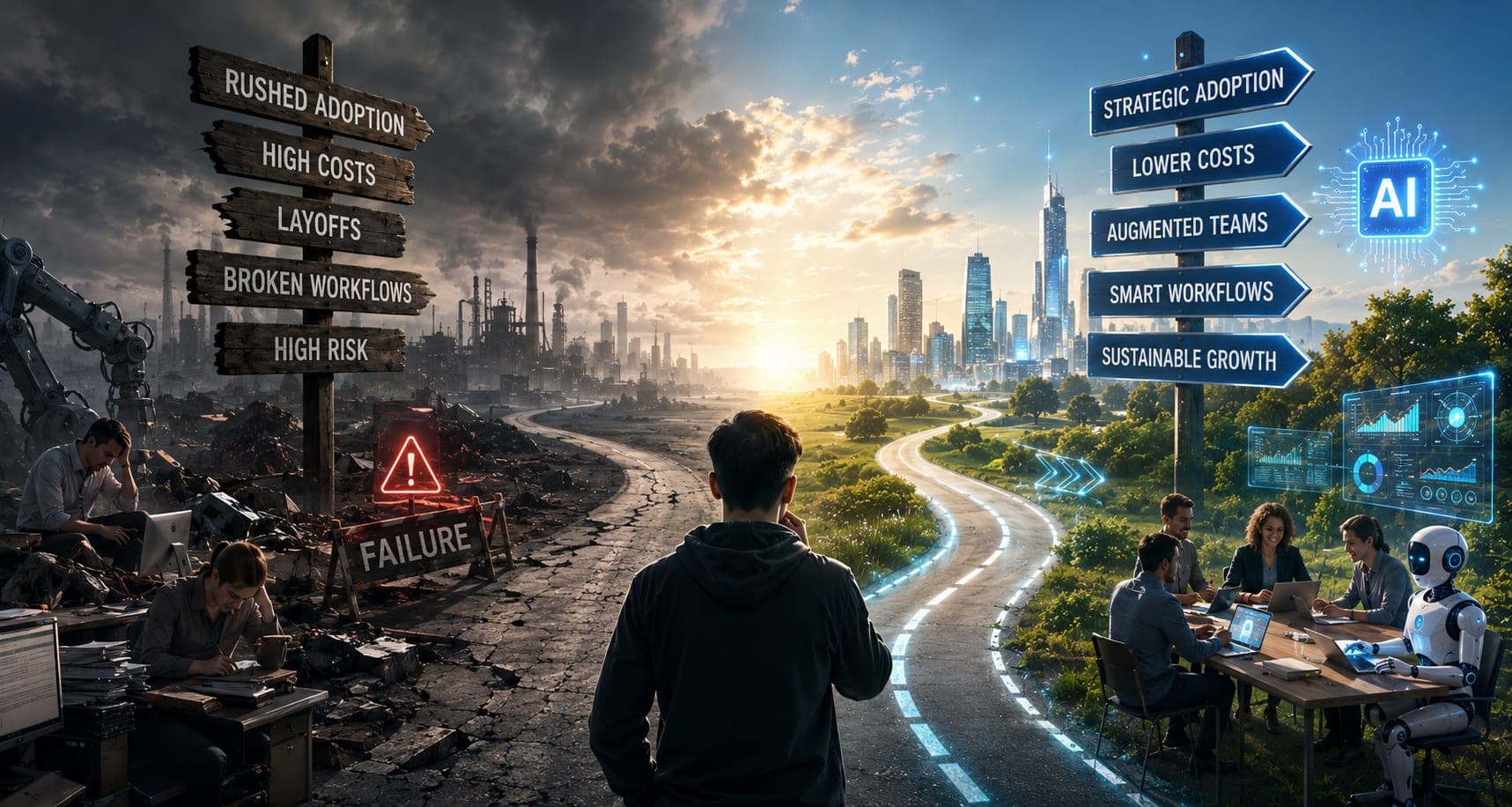
Everywhere you look now, companies are talking about AI.
- “AI-powered.”
- “AI-first.”
- “AI automation.”
- “AI replacing jobs.”
- “AI workforce.”
At this point, Artificial Intelligence has become part of almost every business conversation. And honestly?
I think many companies are moving too fast with AI adoption without actually asking the important questions first.
Don’t get me wrong. AI is amazing. I use AI daily. build with AI. integrate AI into workflows and believe AI is here to stay.
But one thing I keep saying is this:
“AI is not a fix-all problem tool.”
That statement alone changes how you approach AI adoption entirely. Because right now, most companies are not adopting AI strategically; they are adopting AI emotionally, and there’s a huge difference between the two.
Most Companies Are Reacting, Not Thinking
One thing I’ve noticed recently is that many organizations are integrating AI because they are afraid of being left behind.
Not necessarily because they fully understand:
- where AI fits into their workflow,
- what should actually be automated,
- what should remain human-controlled,
- the operational tradeoffs,
- the long-term cost,
- or the risks involved.
They just know:
“Everyone else is doing it.”
And honestly, that mindset is dangerous.
Because panic-driven technology adoption usually leads to poor decision-making.
The moment one company starts talking about:
- reducing costs with AI,
- automating workflows,
- replacing departments,
- increasing productivity,
- or scaling faster,
every other company suddenly feels pressure to move at maximum speed too. But here’s the thing I think many people overlook:
“Speed without focus or direction usually ends with a big crash.”
In technology, speed definitely matters. But speed without understanding the consequences?, That’s where problems start.
The First Thing I Like Asking Before Any AI Conversation
One thing I’ve realized about myself is that before I draw conclusions or provide solutions, I like asking questions first.
And honestly, I think that’s missing from many AI conversations today.
Whenever people discuss AI adoption, the conversation is usually around:
- replacing jobs,
- increasing productivity,
- moving faster,
- automating workflows,
- staying competitive,
- and reducing human involvement.
But almost nobody talks about the actual tradeoffs involved.
For me, there are two major factors every company should evaluate before aggressively adopting AI:
1. Cost
And I don’t just mean paying for
ChatGPT subscriptions. I mean the actual operational cost of integrating AI properly into a company's workflow.
Because AI adoption is not cheap. A lot of companies rush into AI believing:
“AI will automatically reduce our expenses.”
Then a few months later they realize they are now paying heavily for:
- AI APIs,
- cloud infrastructure,
- GPU servers,
- AI monitoring systems,
- engineering support,
- maintenance,
- security,
- integrations,
- AI tooling,
- and continuous optimization.
Some companies eventually discover:
“We are spending more maintaining the AI workflow than we spent running the original workflow.”
Especially startups. And honestly, I think many growing companies underestimate this badly.
2. Expertise
The second thing people rarely discuss is expertise. How knowledgeable is the company actually?, Does the organization truly understand:
- AI limitations,
- AI hallucinations,
- workflow dependency,
- security implications,
- operational risks,
- failure recovery,
- monitoring,
- and AI oversight?
Because AI is powerful. But AI without proper understanding becomes dangerous very quickly.
A lot of organizations are integrating AI into critical systems without fully understanding how those systems fail. And that’s risky.
AI Should Start as an Assistant, Not a Replacement
Personally, I think this is one of the biggest mindset shifts companies need right now.
The first step in AI adoption should not be:
“How do we replace employees?”
It should be:
“How do we integrate AI to assist employees for better performance?”
There’s a huge difference between those two mindsets. AI works best initially as:
- An assistant,
- A workflow enhancer,
- A repetitive-task helper,
- A support tool,
- or a productivity booster.
Not immediately as a replacement system controlling everything. But many companies are skipping this phase entirely.
Instead, they jump straight into:
- aggressive layoffs,
- full automation,
- AI-first restructuring,
- removing human oversight,
- and replacing entire workflows.
Then a few months later they start struggling with:
- poor outputs,
- inconsistent results,
- expensive infrastructure,
- broken workflows,
- dependency problems,
- and operational instability.
And honestly, this is where many companies are getting AI adoption wrong. and
replaced Workers with AI, bacfireBecause AI still requires:
- supervision,
- correction,
- validation,
- and human judgment in many scenarios.
Especially in sensitive workflows.
Not Every Task Should Be Automated
This is another thing people don’t like hearing. Just because a task CAN be automated doesn’t mean it SHOULD be automated.
We already saw this happen during the automation era years ago. Companies became obsessed with automation.
Everybody wanted to automate:
- customer support,
- operations,
- reporting,
- communication,
- manufacturing,
- and almost everything else.
Then reality hit. Many companies eventually realized:
- some workflows lose quality when over-automated,
- some tasks still require human judgment,
- and some automations simply were not worth maintaining.
AI is heading in that exact same direction.
Right now many organizations are trying to integrate AI into every possible workflow without asking:
“Is this actually worth automating?”
That question matters a lot more than people realize. Because sometimes:
- the maintenance cost becomes too high,
- the workflow becomes too fragile,
- human oversight is still required,
- or the operational risk becomes unacceptable.
Not every task benefits from AI integration. And companies need to become comfortable admitting that.
Failure Tolerance Is One of the Biggest Things Companies Ignore
This is honestly one of the most important parts of AI adoption that I think companies are overlooking badly.
Before giving AI full control over any workflow, organizations need to analyze the failure tolerance of that task.
Meaning:
“If the AI fails, how damaging is the outcome?
And more importantly, how quickly can the company recover from that failure?”
That second question matters a lot.
Because in real business operations, failure itself is not always the biggest problem. Sometimes the real problem is recovery time.
Some AI failures are small inconveniences:
- a wrong email draft,
- a formatting issue,
- a minor reporting error,
- or a low-risk workflow mistake.
Those failures are usually recoverable quickly. But other failures can become dangerous:
- security-related decisions,
- financial workflows,
- healthcare systems,
- customer trust systems,
- infrastructure automation,
- legal processes,
- or sensitive operational systems.
In those situations, the issue is not just:
“Did the AI fail?”
The bigger question becomes:
“How fast can the company recover when it fails?”
Because some failures:
- damage customer trust,
- interrupt operations,
- expose sensitive data,
- create financial losses,
- or cause downtime that businesses may struggle to recover from quickly.
And honestly, I think many companies integrating AI aggressively are not evaluating recovery capability properly. A lot of organizations are asking:
“Can AI automate this task?”
But they are not asking:
- What happens if the AI gets this wrong?
- How quickly can we detect the issue?
- How quickly can humans intervene?
- Is there a rollback process?
- Do we have operational redundancy?
- Can the business continue functioning while the issue is being fixed?
- Is the recovery process simple or operationally expensive?
Those are extremely important operational questions. Because AI integration without recovery planning is risky, Especially when companies begin giving AI systems full workflow control.
For me, one of the smartest ways to evaluate AI integration is not just by asking:
“Can AI do this task?”
But also asking:
“How survivable is failure if AI gets this task wrong?”
That changes the conversation completely. Because not every workflow has the same failure tolerance, and not every company has the same recovery capacity.
AI Adoption Should Happen Gradually
Personally, I believe gradual AI adoption is the smartest approach. Especially for:
- startups,
- growing businesses,
- and companies still building operational structure.
I don’t think organizations should suddenly turn every department into an AI-powered workflow overnight.
A better strategy is:
- analyze workflows department by department,
- identify repetitive tasks,
- determine low-risk operational areas,
- introduce AI gradually,
- measure impact,
- evaluate tradeoffs,
- then scale carefully.
This gives companies room to:
- understand operational impact,
- monitor performance,
- train employees,
- and recover safely if something goes wrong.
Because another thing people ignore is this:
“AI dependency grows very quickly once workflows become automated.”
And reversing bad AI integration decisions later can become expensive.
Companies Need to Stop Comparing Themselves Blindly
Another thing I think about a lot is when companies say:
“We need to move faster with AI.”
My question usually is:
“Compared to who?”
Are startups comparing themselves with billion-dollar tech companies? Or are they reacting to social media pressure?
Because there’s a massive difference, Large technology companies have:
- massive infrastructure,
- AI research teams,
- GPU clusters,
- operational redundancy,
- AI engineers,
- recovery systems,
- and billions in capital.
Most startups do not.
Trying to copy the AI adoption pace of companies operating at an entirely different scale is dangerous. And honestly, I think social media hype is making this even worse.
A company sees another company aggressively integrating AI and suddenly feels pressured to do the same immediately.
But sustainable business growth has never been about blindly copying trends.
Companies Should Break Down Workflows Before Integrating AI
Another thing I think organizations should start doing more is logically breaking down their departments and workflows before introducing AI deeply.
Instead of trying to make the entire company AI-powered immediately, companies should:
- analyze departments individually,
- understand workflow sensitivity,
- identify repetitive tasks,
- identify high-risk operations,
- and determine where AI genuinely provides value.
Some tasks are perfect for AI assistance, some tasks are safe enough for AI to handle almost fully, and some tasks should absolutely remain heavily human-supervised.
The mistake many companies are making right now is treating every workflow equally. But not every workflow has:
- the same sensitivity,
- the same recovery tolerance,
- the same operational impact,
- or the same security requirements.
That difference matters a lot.
The Companies That Will Win Long-Term
Honestly, I don’t think the companies moving the fastest with AI will necessarily win long-term. I think the companies that will succeed are the ones that:
- integrate AI strategically,
- understand the tradeoffs,
- evaluate operational risks,
- train their teams properly,
- move with direction,
- and know where AI genuinely creates value.
AI is powerful, very powerful. But reckless AI adoption can damage a company just as fast as ignoring AI completely.
The goal should not be:
“Replace humans with AI”
The goal should be:
“Use AI to make humans and workflows more effective.”
And honestly, I think the companies that understand that early will build stronger and more sustainable systems long-term.
Successful AI adoption is not about hype, It is about:
- balance,
- direction,
- operational awareness,
- risk management,
- recovery planning,
- and understanding where AI truly belongs inside a workflow.